The platform
A workspace for the next clinical action.
Follow-up lists, decision support, medicine stock, and programme reports stay in one record.
Explore the platformFrom the next participant contact to the district overview. EpiCare connects clinical follow-up, medicine coordination, and programme teams in one workspace.
Field use in East Singhbhum, Jharkhand.
Built for clinical care, medicine operations, and programme oversight.
EpiCare is the product. The East Singhbhum implementation shows how a district service used it. Those are related, not the same thing.
The platform
Follow-up lists, decision support, medicine stock, and programme reports stay in one record.
Explore the platformField implementation
Nine block catchments and urban Jamshedpur. Published programme findings describe reach and continuity. They do not, by themselves, prove product effectiveness.
ONE PLATFORM. CONNECTED RESPONSIBILITIES.
Care does not end at a recorded visit. Bring clinical follow-up, medicine coordination, programme insight, and team management into a connected workspace.
Bring registration, scheduled contacts, assessments, and clinical history into one longitudinal workflow. Facility-specific worklists help teams see who needs contact next.
Bring assessment information and clinical prompts into the care workflow. Support review of medication, reported seizures, interactions, and concerns while preserving the clinician’s role.
Coordinate monthly medicine indents across CHOs, primary care facilities, and district teams. Follow requests, dispatches, and recorded stock through role-specific views.
Explore recorded activity by facility and period. Bring follow-up, seizure reports, medication-taking, referrals, and workload into programme conversations.
Manage districts, facilities, and users with role-based access. Keep teams and programme oversight connected. Authorised super-admins adapt forms within the management area.
Schedule consultations, review status and history, and organise seizure-video records within the care workflow.
Bring NDDI-E screening and recorded concerns into longitudinal follow-up, with clinical review when indicated.
Explore classification and predictive modules with their evaluation status kept separate from the field cohort findings.
1,218
Observational cohort in East Singhbhum, Jharkhand
9,035
Repeat contacts across the registered cohort
819 (67.2%)
Participants never treated or who had discontinued treatment
Source: published programme findings from the East Singhbhum field implementation. Read the outcome definitions and findings.
THE APPLICATION, IN ITS OWN WORKSPACE
Open the application interface in a separate demonstration. Choose a role and explore the existing care, stock, reporting, and management workflows with synthetic records.
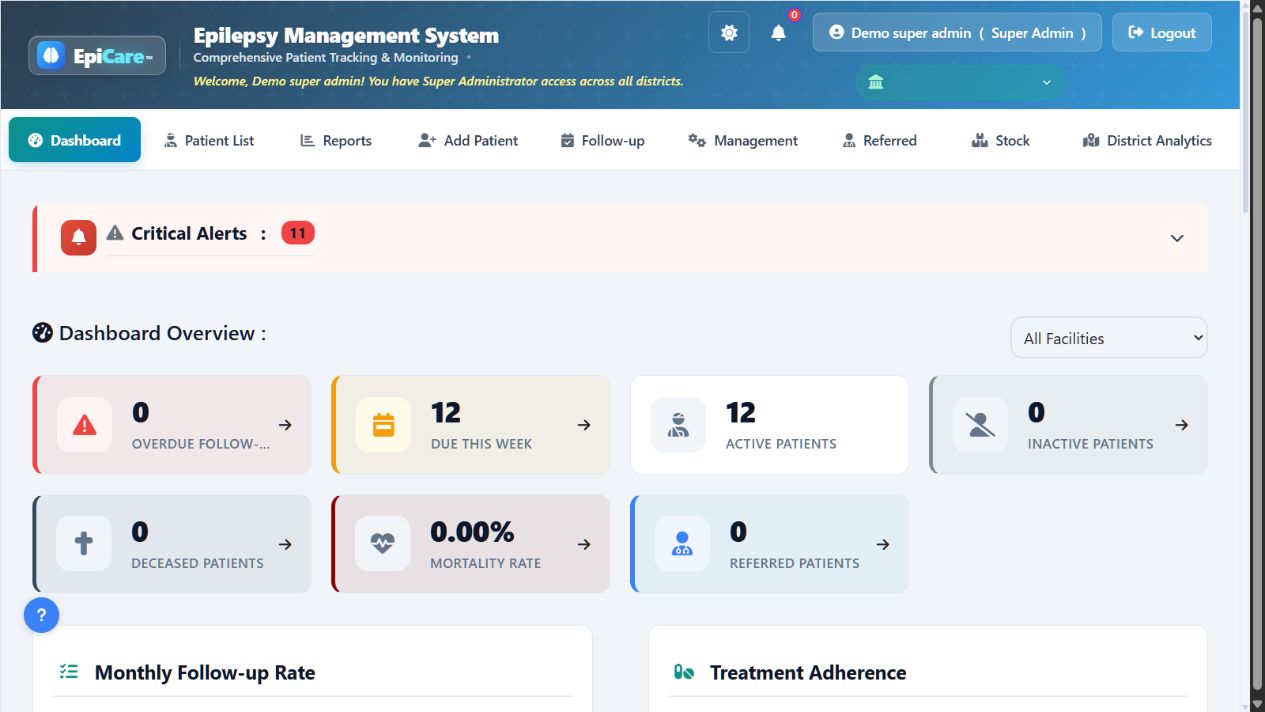
Select a role to pause the sequence and see the handoff EpiCare is meant to carry.
ASHA / Sahiya
Community workers identify people who may have epilepsy, support attendance, and keep a local link to the next clinical step.
A named person reaches assessment with a community contact, not a lost referral.DIFFERENT ROLES. SHARED CONTEXT.
Give each team a clear view of its work, while keeping the person’s care connected across services.
For CHOs
Start with the people due for follow-up. Record a structured assessment, document medicine access, and bring concerns to medical review.
PUBLISHED PROGRAMME FINDINGS
In East Singhbhum, Jharkhand, the field service linked specialist assessment with CHO-led follow-up, ASHA support, and EpiCare documentation.
Published programme findings follow participants registered from 11 August 2025 to 30 September 2026. They describe reach, continuity, and reported clinical outcomes.
Explore the study and its contextExplore consultation recording, transcription, evidence extraction, and expert review. Processing depends on configured services. The field cohort evaluates the care pathway, not LGDEA performance.
Browser-based audio recorder captures the clinical consultation in real time. No additional hardware required.
Automatic Speech Recognition (ASR) converts the audio stream to raw text with speaker diarization.
The proposed workflow includes identifier removal before downstream analysis, subject to privacy evaluation.
A clinical NLP layer pulls structured evidence: symptoms reported, medications mentioned, seizure frequency disclosed.
Discordance is flagged: symptoms inconsistent with the prescribed treatment plan are surfaced for the reviewing clinician.
The proposed workflow includes expert review of uncertain findings before clinical use.
ACCESS IN FIELD CONDITIONS
EpiCare includes browser-based access, supported offline operations, synchronisation controls, and nine interface language bundles. Review the supported workflows and devices for each deployment.
The application retains its responsive navigation, forms, worklists, and clinical records across supported browsers.
App-shell caching and queued operations are part of the application. Offline authentication and synchronisation require deployment-specific setup and are not enabled in the isolated public demonstration.
English, Hindi, Bengali, Tamil, Telugu, Malayalam, Kannada, Marathi, and Punjabi. The application demonstration uses its actual language selector.
Low-bandwidth facilities can keep the app shell and queue supported submissions. The queue is not a claim that every service works offline.
IMPLEMENT WITH INTENTION
Plan the people, clinical review routes, medicine coordination, and recording workflows around the technology.
Map the local care pathway, facilities, team responsibilities, medicine arrangements, and clinical review routes.
Agree facility structure, access roles, supported forms, reporting needs, and the workflows to introduce.
Plan role-specific training, clinical supervision, data governance, devices, and connectivity.
Start with defined workflows. Review contact patterns, recording quality, medicine coordination, and feedback before expanding.
Start with your programme’s needs and the workflows that matter most.
Plain answers on who the product is for, what the demonstration contains, and how to read the field findings.
EpiCare is open for partnerships with state health departments, academic medical centres, and public health funding bodies. Discuss training, local workflows, and implementation requirements with the team.
Discuss care workflows, staff training, and implementation across your primary care network.
Explore the observational cohort findings and discuss research collaboration.
Learn More →Discuss programme evidence and priorities for strengthening continuing care.